

There are many anime adaptations of games that feature outstanding soundtracks. It’s hard to say exactly why—perhaps because the worldbuilding is already firmly established in games, or because there’s more flexibility in the production schedule compared to anime-only projects. Whatever the reason, many people seem to feel this way.
One of the most memorable game-based anime soundtracks, in my opinion, is that of STEINS;GATE. Of course, its brilliance also comes from the compelling story and fascinating characters, but the soundtrack plays a vital role in immersing the viewer in its world.
The main theme, “Gate of Steiner,” often heard in both the anime and the soundtrack album, uses just a solo piano. With only melody and chords, it evokes a scene that is both beautiful and fragile—truly exceptional in its emotional expression. Other tracks as well use dissonance to subtly intensify the narrative, evoking unease, mystery, and the taboo of time-leaping. The effect may not feel like “excitement” in the conventional sense, but it undeniably enhances the story on a deeper level.
In this piece, I’d like to explore why the STEINS;GATE soundtrack feels this way, and what makes it so effective.
1.The Shared Worldview and Contrast with the Theme Song of STEINS;GATE
In the anime’s openings, the theme songs across the series all share certain characteristics: a relatively fast tempo with plenty of four-on-the-floor beats that make the songs easy to groove to; a strong presence of futuristic tracks; and frequent use of key changes or substitute chords in the melodies.
By contrast, most of the background score is restrained, with piano taking the lead and string instruments such as violins and violas only added sparingly in scenes with emotional ups and downs. Rather than creating a sense of forward-driving momentum through rhythm and melody, the score conveys everything through the timbre of analog instruments—that is, through melody itself—making for a bold, expressive choice. It is also interesting that the main theme’s melody, mentioned earlier, is scattered throughout other tracks in the score. Precisely because the methods of expression are so contrasting, the anime gains a greater sense of depth and range.
2.Effective Ways of Incorporating Dissonance
There are many pieces that make incredibly skillful use of dissonance, but I’d like to focus on just one. Among the tracks in STEINS;GATE, an especially important one is “Mayuri’s Sadness”, named after Mayuri Shiina, or “Mayushii.” If you listen to the very first chord of dissonance in this piece, you can almost feel a sense of emotional blockage—confusion, hesitation, and inner conflict. Then, as the melody continues, it becomes clear that this sadness stems from the character’s kindness. Beginning with dissonance and then weaving the character’s emotions and scenery into a single musical narrative, the composition is nothing short of moving.
Why Does This Touch Our Hearts
The unique appeal of a soundtrack lies in the strong bond between music and visuals. It’s not as simple as saying that a piece sounds sad just because it makes heavy use of minor scales or chords. Rather, as mentioned above, the unease and urgency conveyed through dissonance fit perfectly with the on-screen expressions, emotions, and inner struggles of the characters at that moment. STEINS;GATE makes the most of this strength to its fullest.
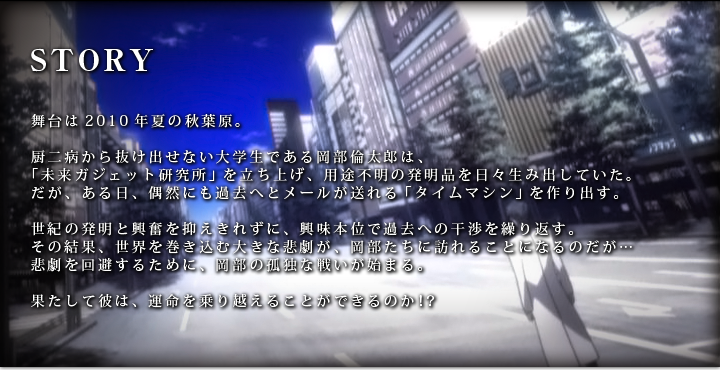
Of course, this impact is only possible because of the story’s dynamism and depth. A grand narrative unfolds around the protagonist, Rintarou Okabe, who, as the “Observer,” dares to defy even the gods by using “time-leaps” to return to the past again and again, never giving up. The soundtrack, filled with masterpieces worthy of such an epic tale, is best experienced once more while recalling the story itself and its many unforgettable scenes.
According to the Official Steins;Gate