

Well, we're down to the last one. Yuki Hayashi.
My encounter with Yuki Hayashi was through Haikyu!! But when I looked into it, it turned out that nearly all my favorite works were Yuki Hayashi's.
There are so many that I won't bother listing them here, but I really do want anyone reading this to look into it for yourself.
Your own favorite "Yuki Hayashi" is definitely in there somewhere!
Now, back to the story—the first corner is Ao no Miburo (The Blue Wolves of Mibu).
It had only just started airing, but the voice actors rushed in to promote it.
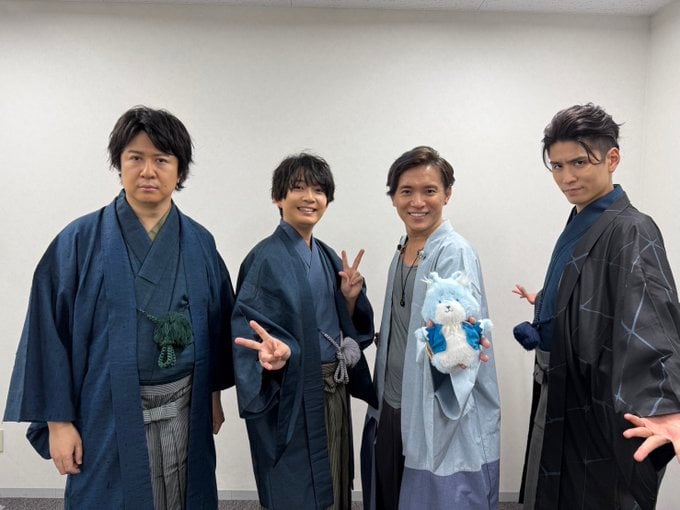
Their costumes weren't quite the Shinsengumi haori, but they looked just like the ones the Shinsengumi wear in the first episode.
It had been featured at Kyo-Banmatsuri, so I'd watched episode one of the anime—and out came Shuichiro Umeda, who voices the protagonist Chirinui, Yohei Azakami as Toshizo Hijikata, and Tomokazu Sugita as Isami Kondo.
I've loved historical pieces since I was young, and I'm relatively fond of every era, but my absolute favorite has to be the Bakumatsu period.
To the question of how they felt about their own characters, each of the three gave their own take, but Sugita's answer was the one that gave me the most to think about.
Take Liu Bei from Romance of the Three Kingdoms, for example. In the handed-down tradition, he's a man of virtue, loved by all, never forgetting his sense of justice.
But change the work, and Liu Bei might be portrayed as a manipulative charmer—cruel, calculating, a cunning strategist.
Isami Kondo is famous, but how he climbed all the way to becoming chief commander isn't depicted much.
He was the kind of guy who could fit his own fist in his mouth, and in swordsmanship Hijikata and Okita were better—so maybe he was actually quite the strategist?
Hearing this story, I made up my mind to watch it.
And after a few questions, despite an hour of getting dressed, they had to leave the stage after just ten minutes.
Aww, I wanted to hear more.
But "a little more" is probably just the right amount, you know?
Closing out the Ao no Miburo corner was the main theme, "Mononofu."
Before it started, a video message arrived for Hayashi from a mysterious figure, and when we opened it, there was OzWorld, the vocalist of "Mononofu."
He apologized that he couldn't take part because he was on tour.
And so "Mononofu" was performed with OzWorld absent.
Man, the rap is incredibly cool!! Why isn't he here?! OzWorld!!
I wanted to hear the rap live. I bet they got to hear it live at Kyo-Banmatsuri—a little envious.
And so we dove straight into Yuki Hayashi's corner.
Actually, Hayashi changed up his setlist quite a bit from Kyo-Banmatsuri, and the first song was "Insomniacs After School," sharing its title with the work.
It's apparently a romance about a guy and a girl who both have insomnia—a work I knew nothing about.
The idea is that precisely because they have insomnia, they head to the observatory at night to look at the stars together.
At this point Hayashi said something startling.
"Everyone in the venue, turn your phones on and wave them instead of penlights."
Huh?! Is that allowed?! Doing something like that?!
This is something absolutely unthinkable in film or theater culture!
Soyogi Bon literally told us to turn our phones off!
While I sat there bewildered, agonizing over whether to turn my phone on, the person next to me, and then the person in front of them, started turning their phones on.
And just like that, finishing the second song from Insomniacs After School, "The Invincible Two," Hayashi looked satisfied.
"It was as beautiful as a field of stars."
Never have I wanted so badly to look out over the venue from up on stage as I did at that moment.
Next was Haikyu!! A work I love too.
That said, I'd missed only the film The Dumpster Battle—streaming was rental-only, so I'd been on the fence.
Haikyu!! up to now had a main theme called "Above," but
apparently for the film they were asked to make a main theme with a different arrangement. Even so, nothing came to him, until
he watched the voice actors recording their lines, was so moved that the moment he got home he wrote it in one go.
That's the title track, "The Dumpster Battle."
Where "Above" is a pretty up-tempo song, this one is a slightly gentler melody that announces the story's prologue.
After "The Dumpster Battle" came "Above," then "My Win."
"My Win" is a film arrangement of "Above" that really brings out the coolness of "Above."
Next, two songs from the fantasy world: "Wistoria: Wand And Sword" from Wistoria: Wand and Sword.
Fantasy is apparently tricky in all sorts of ways, and Hayashi said he agonized quite a bit over how to express it.
When the first song ended, a guest appeared... a woman named Jun Futamata.
It's a song that plays in an incredible scene in episode 11 of the anime—a phantom masterpiece not yet on sale.
The title apparently isn't even decided yet; per Jun, it's the "Wistoria: Wand and Sword Main Theme, Fictional-Language Ver."
The crystalline clarity of her voice combined with the Irish-sounding fantasy lyrics made for a wonderful song.
Jun apparently sings in the languages of various countries, and she said inventing a fictional language was a ton of fun.
Jun herself apparently composes scores too, so maybe next time it'd be worth having her appear as a composer.
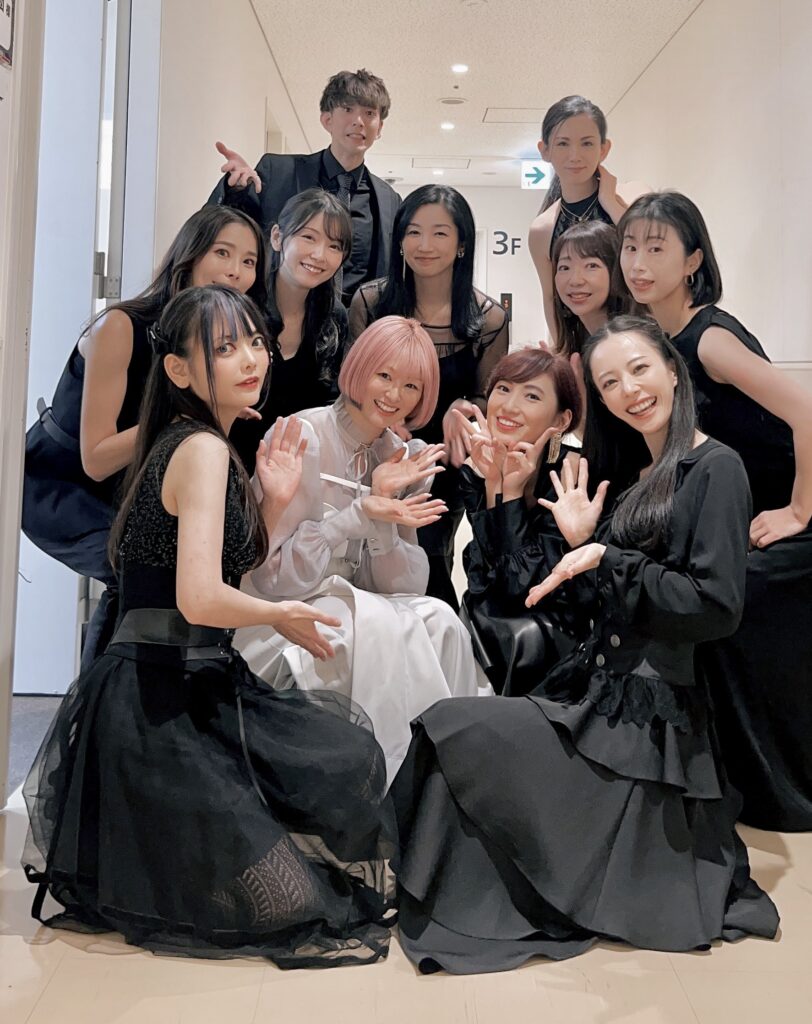
(The one with pink hair is Jun.)
Here's Jun's X account ↓
Jun Futamata
@junfutamata
Now, here Hayashi speaks up.
"Do you all like Gundam?"
Yes! Yes! Yes! Yes! I love it!
"Well, in my case, when I say Gundam I mean the plastic-model anime, though."
Yes! I own every protagonist's machine in Gunpla!
Hayashi tells us. How there was talk of making a Gundam in which no one dies.
How, when the offer came for a work called Metaverse, he answered, "Even without time, I'll do it!"
How in Metaverse there's a scene where the protagonists and rivals of past series reunite to fight once more, and personally that's his favorite part.
How he loves video editing so much that, if he weren't a composer, he might have become a video editor.
And then the song that began was the theme of Gundam Build Metaverse.
Here, footage condensing all three episodes of Metaverse played, with a fiery song to match.
And then, having waited for just the right moment, footage from Gundam Build Fighters rolled.
Build Fighters is my favorite of the Build series.
From the Fighters scenes: Sei Iori and Reiji fighting side by side. The fierce battle against Meijin Kawaguchi! And the high-five Sei and Reiji never got to share.
And then, in the Metaverse space, the reunion of Sei and Reiji. And with Meijin Kawaguchi standing in their way, Sei and Reiji fight side by side again after years apart.
The music and the way the footage unfolded matched so well that I couldn't help letting out a roar of "As expected of Hayashi..."
And then, from Karakuri Circus, "Arlequin."
Before the show, the PV had played on screen, and at that time it was a voiced promo.
The author, Kazuhiro Fujita, has such a powerful way with words! A factory mass-producing legendary lines, churning all sorts of them out.
And yet, Karakuri Circus was the one I'd missed.
It's on Amazon Prime!! Decided!! Hayashi's "definitely watch this" anime is Karakuri Circus!
When "Arlequin" ended, Hayashi said:
"From here there's no footage, so feel free to take photos. And spread them on social media!"
Are you seriously sure?!
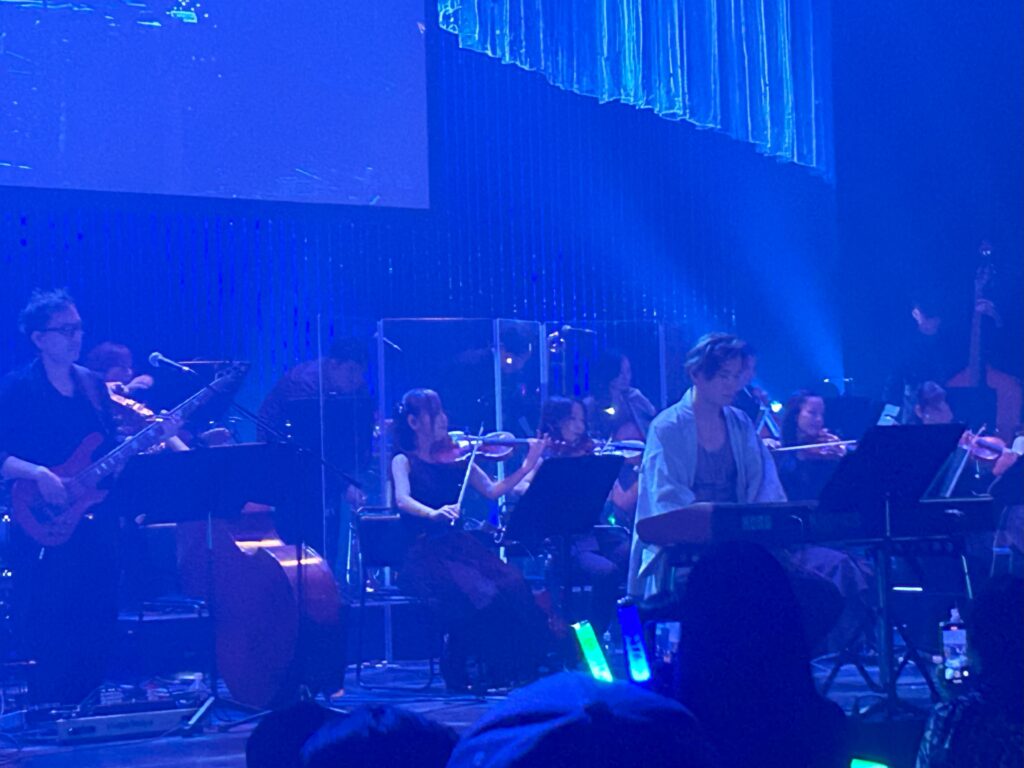
From here on, it was a sprint:
from the film My Hero Academia, "Next, it's our turn!" and "The Trinity."
And from The Dumpster Battle, "After the Festival" played.
The venue's voltage faithfully carried over the heat Kato and Takanashi had built up,
and just as the fervor broke past its limit, like fireworks going off—BANG!—a kusudama ball burst open with a huge sound, and golden streamers fluttered down from the ceiling!
With most of the crowd on their feet in a standing ovation, there came the final interview.
"This time, my thanks to the bigwigs of Toshima Ward who let us hold such a reckless event!
Let's not make it end with just this one time—let's keep it going next year, the year after, and on into a world tour!
For that, your cooperation is absolutely essential! I'm counting on you all from here on out!"
And so, Tokyo Banmatsuri came to a close.
For the anime I haven't seen, the joy of encounters yet to come.
For the anime I had seen, the thrill of learning a new way to enjoy them—each waiting for me.
I think it anew. My thanks to the person who let me write this article, who let me take part in this event—.