

The high school I attended had a broadcasting club. And apparently it was a fairly elite broadcasting club within Hokkaido, said to be a regular at the national tournament. Honestly, I knew about national tournaments for sports clubs, like Koshien or the Inter-High, but a national tournament for a culture club didn't ring a bell at all. To begin with, I had no idea what a broadcasting club even did as a club, or what they competed over against other broadcasting clubs nationwide. I imagine that's the case for any ordinary high schooler. Hana wa Saku, Shura no Gotoku is the story of a girl who loves recitation joining a broadcasting club and chasing her dreams. In episode one, the protagonist Kana Haruyama happens to be recruited into the club by an upperclassman who saw her reciting, but even when she hears about the broadcasting club's national tournament, the NHK National High School Broadcasting Contest, it doesn't seem to register with her. She's surprised to hear that 16,000 people participate, but honestly my reaction was, for that many participants, it sure isn't well known. I think viewers probably had pretty much the same reaction in this scene. Japanese manga is incredibly diverse. There are baseball manga and soccer manga that remain stubbornly popular; among the famous ones, there's basketball manga, tennis, judo... sports have quite a lot of manga drawn about them, but over the past decade or so, culture-club manga has become quite prominent too. Even without the easy clarity of sports or martial arts, the effort, the inner conflict, and the heated drama within them are no different from athletic clubs. Original creator and novelist Ayano Takeda depicted the youth of a brass band club in Sound! Euphonium as well, and she has a tremendously deep grasp of the youth of culture clubs, which comes through clearly in her careful, meticulous depiction, and that's really wonderful.
Conveying the Inner Conflicts and Subtleties of Youth Through the Score
In a novel, you can directly write a character's inner heart in prose, but anime is different.
You have to express emotion through a character's expressions, the tremor and breath in their voice, scene direction, and the score.
And this anime is extremely good at it.
Take, for example, a striking scene in episode one, where the upperclassman Mizuki Usurai, as broadcasting club president, reads a poem to the new students: the score that comes in features an ominous piano at a barely-tolerable pitch that almost sounds discordant, paired with reverse strings. And the upperclassman walks boldly through a pitch-black scene, while the protagonist, careful not to step off the rail faintly visible at her feet, is nonetheless afraid of taking that first step into the unseeable distance. The staging has the piano's notes shift into a powerful minor chord, and the melody gradually grows clearer... And precisely because the score had been used only minimally up to that point, the sound and staging that suddenly flow in here give you a jolt.
Even so, the protagonist still can't quite take that first step toward what she wants to do, and she heads home as the story moves on, but the scene has enough power to convince you that her heart may already have been made up right here.
Of course the score plays during everyday scenes too, but perhaps because this anime takes "broadcasting" and "recitation," things that likewise appeal to the ear, as its subject, there are many scenes where it treats the score with great care and uses it as the linchpin of its staging.
I have no objection that anime is, fundamentally, something to watch with your shoulders relaxed, but when you watch an anime whose intent to "convey something!" is this easy to grasp, you really understand the importance of the score, and I think you'll start being able to see, when watching other anime too, the parts you'd been taking in unconsciously.
For that alone, this anime is unquestionably worth watching! Please, do.
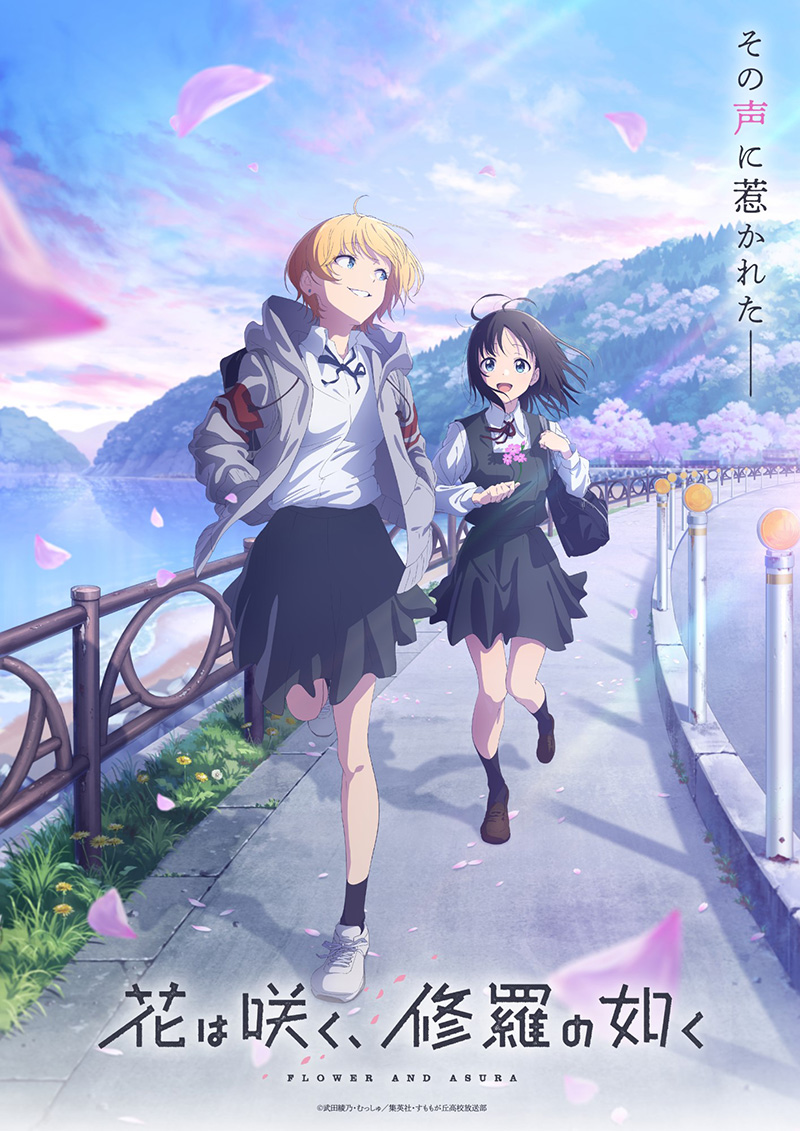
Quoted from the official site https://hanashura-anime.com/#index