

Making a living from music — most ordinary people would consider that quite the pipe dream. Kids these days come across as somehow realistic; the ones who think "I'm going to make my music known to the world" are a minority, and I get the impression most think more along the lines of "if I happen to break out while I'm still a student, maybe taking the music path is an option." It's a manga so it's different, but even the protagonists of the very popular manga Futsuu no Keionbu ("An Ordinary Light Music Club") don't hold up a dream of aiming for a major-label debut — instead they set their sights on something like wanting to play the closing slot at the school festival. Of course that's just a manga, but among the young people around me — I've kept up musical activity for about 25 years myself — there are plenty who, even after getting fairly well known locally, drop music in a heartbeat upon graduating. I won't go as far as my own situation, where I've kept dragging music along until none of my contemporaries (excluding those who made it) are still doing it, but lately you don't see many people who say, "I'll keep chasing my dream until I'm 30!" either. And that's not wrong at all — if anything, cutting your losses early and giving up on yourself is a smart move. Making a living from music is realistically that harsh; it's a world where only a far smaller handful than you'd imagine get to remain. The same is probably true not just of music but of the worlds of illustration and manga, acting and voice acting too. But even if you stumble somewhere along the way, the time you spent chasing your dream is something precious and irreplaceable, something to treasure. People chasing a dream right now, and people who've given up on their dream, can both thoroughly enjoy the anime BLUE GIANT. If you aspire to music, or once did, please read the original manga too. It's bound to hit home.
BLUE GIANT is a jazz manga. The protagonist is a boy entranced by the saxophone, who keeps practicing relentlessly while chasing his dream of "becoming the world's greatest player." Day after day he keeps blowing, moves to Tokyo, and begins to make his dream come true — that's the story. Incidentally, the original manga has been running for over ten years now, with its setting shifting from Tokyo to Europe to America to New York. The film rushes a bit, but it depicts the Tokyo arc — the first part — up through an important crucial live scene.
First of all — obvious as it is for an anime about music — the music is excellent. Using music alone, and with nothing lacking or excessive, it explains why the protagonist is drawn in by the coolness and freedom of jazz he hears.
I'm not sure whether to call it a soundtrack or diegetic songs, but you can hear a wide range, from famous jazz classics to original jazz written for this film. The power of the visuals is something, but the power and persuasiveness of the sound is truly wonderful (please listen at the loudest volume your environment allows).
In particular, the way the drum sound keeps getting better and better, and the parts where the piano solo suddenly turns aggressive and attacking, sound like a payoff of the early line, "Within this sound, you're free (to play any note)," and I felt that even the story's structure was woven into the music with a great deal of thought.
The soundtrack composer is Hiromi Uehara, who has a personal connection with the original creator Shinichi Ishizuka — and just as she praised it, saying she could "hear the sound coming out of the manga," this is a marvel of a work that drags that sound out of her head — no, out of the manga itself — and makes it real.
Composing the score for the parts where the live performance becomes a piano-less duo (drums and sax only) must have been quite the adventure for Uehara, a pianist. The diegetic songs, which grab hold of sounds wrung out right to the limit, are something I really want you to hear. They're guaranteed to move you.
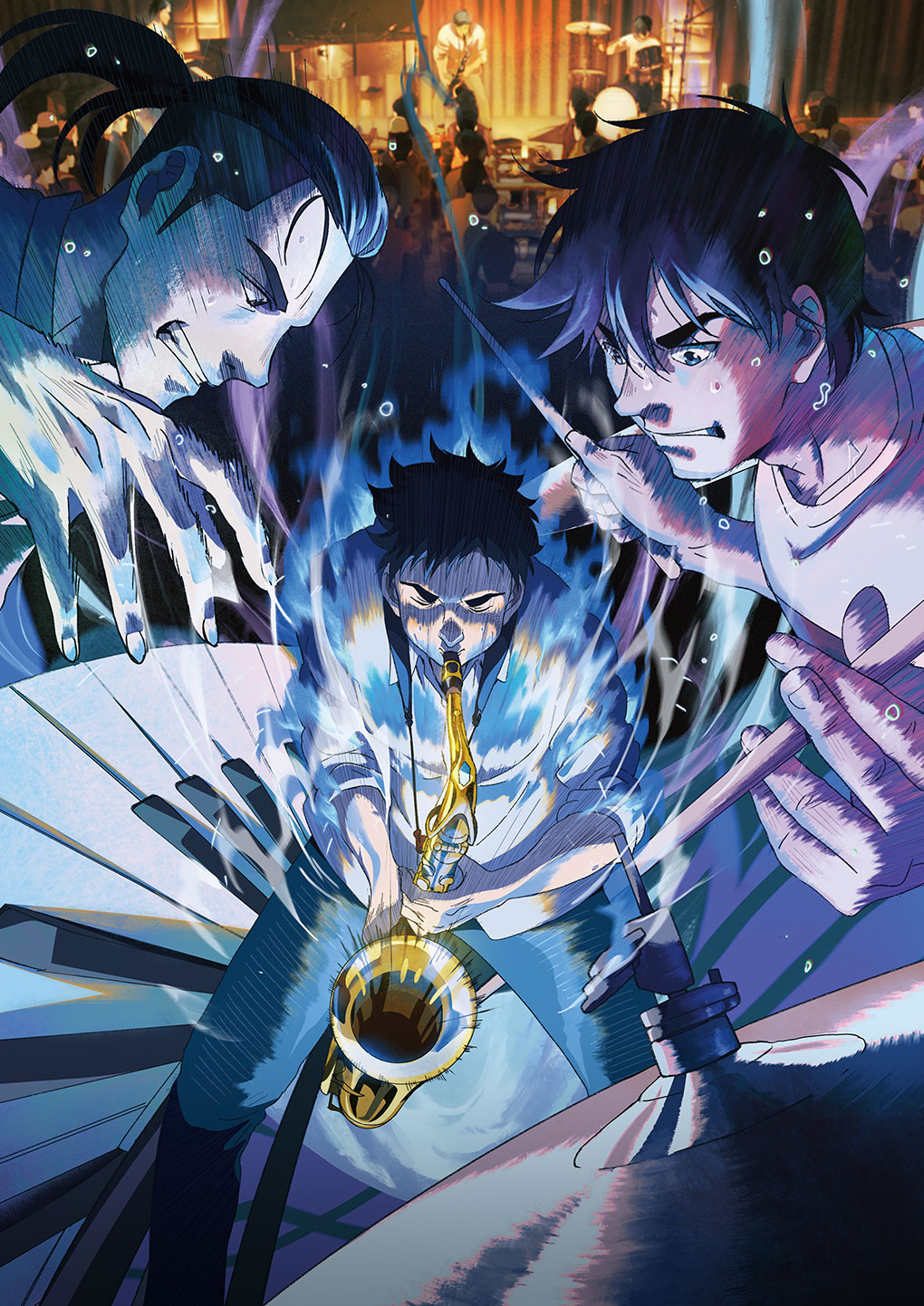
Cited from the official site https://bluegiant-movie.jp/#