

In an age long past, in a world where today's common sense doesn't apply at all, what kind of meaning would truth carry? If absurdities that would make us laugh today were believed as glaring common sense, and if the people living in that era found salvation based on that common sense, then truth, however correct, would be nothing but an awkward, troublesome thing. It's unimaginable to us living in 21st-century Japan, considered one of the safest places in the world, but it's an undeniable fact that in the 16th century, supposedly only some 500 years removed from us, the value of human life was incomparably lower than it is today. And so was any awareness of human rights.
In such circumstances, it feels like a natural flow to want to cling to the theory that going to heaven frees you from the suffering of living. And I understand the urge to think of a place you could never reach in those days—the sky, the cosmos—as heaven, and to be enchanted by it. You really can't see the Earth moving with your own eyes, so it's no wonder people thought the things in the sky were the ones moving. Surely even today, most children would see it that way before they're taught heliocentrism.
This intro has gotten long, but Orb: On the Movements of the Earth is a work that depicts an era when heliocentrism still wasn't believed. In the work, those who advocate heliocentrism suffer fierce persecution and are oppressed, but the author, Uoto, has said that historically heliocentrism apparently wasn't persecuted to that degree (which is the truth is up for debate, and it's unclear whether heliocentrism alone was the reason for oppression). Still, in the original work, things called by fictional names sometimes link up with the real world (I'll keep this vague since saying more would be a spoiler), so you could say the author's own interpretation has been added. I'm really looking forward to how the anime will express this.
A Heavy Story, a Grand Theme, the Heavens. A Magnificent Score That Expresses It All
Orb's score composer is the super-genius Kensuke Ushio. Maybe "genius" is too trite a word to capture him. "Maverick" or "prodigy" might fit better.
This season, Orb is one thing, but in terms of buzz he's also handling the score for Dan Da Dan, which is neck-and-neck for the top spot and a leading candidate for the season's reigning anime. (I've already written an article about Dan Da Dan, so please definitely give that a read too.)
As for Orb's score itself, it's just, well, incredible. Too incredible.
It's basically a quiet anime, and because it values its historical setting, the night scenes are seriously short on light. There are even more silent scenes than not. And that's exactly why the grand pieces used in the starry-sky scenes, the ones that sound like they're imagining the cosmos, shine so brilliantly. When you think of music people recognize as "grand," you tend to imagine pieces with a leisurely tempo, but the score you hear is fast-tempo music with rhythms like breakbeats. There are also lots of unfamiliar sounds in it. I couldn't even tell whether they were the sounds of instruments or something a track maker created.
According to Ushio, there were Gregorian chants in the Europe of that era, and he listened to those chants while looking at sheet music that was entirely different from today's, read the tonal shapes from the music and the diagrams, and built the tracks from there. Then he apparently distilled that into rare-groove breakbeats and sampled it.
It's an absurdly obsessive story and an outrageous level of dedication. From sheet music that's totally incomprehensible—vague measures, differently shaped notes—he researched and extracted medieval music. I work as a composer myself, but a composition method like that is kind of unthinkable. Or rather, even if I thought of it, I couldn't do it; it's such a monumental task it makes my head spin.
Incidentally, when it came time to adapt it into anime, the author, Uoto, apparently insisted that the score absolutely had to be done by Ushio. With someone who does work of this caliber, it's no wonder.
In terms of modern music, take techno-pop, said to have been pioneered by Kraftwerk: with its somewhat inorganic, evenly spaced rhythms, it feels like music with a strong mathematical element. And the way various rhythms ride on top so satisfyingly is just like a starry sky. If breakbeats lie at the end of a branch off that family of "easy-to-groove-to" genres, then music that has it coexist with something like Gregorian chant, which nobody would ever connect with modern music, makes me feel there could be no better score for expressing the starry sky of that era through modern music.
The anime is still in its early stages, but honestly I have no idea what kind of score we'll get to hear from here. If there's one thing I do know, it's just that we're going to be utterly captivated by that music.
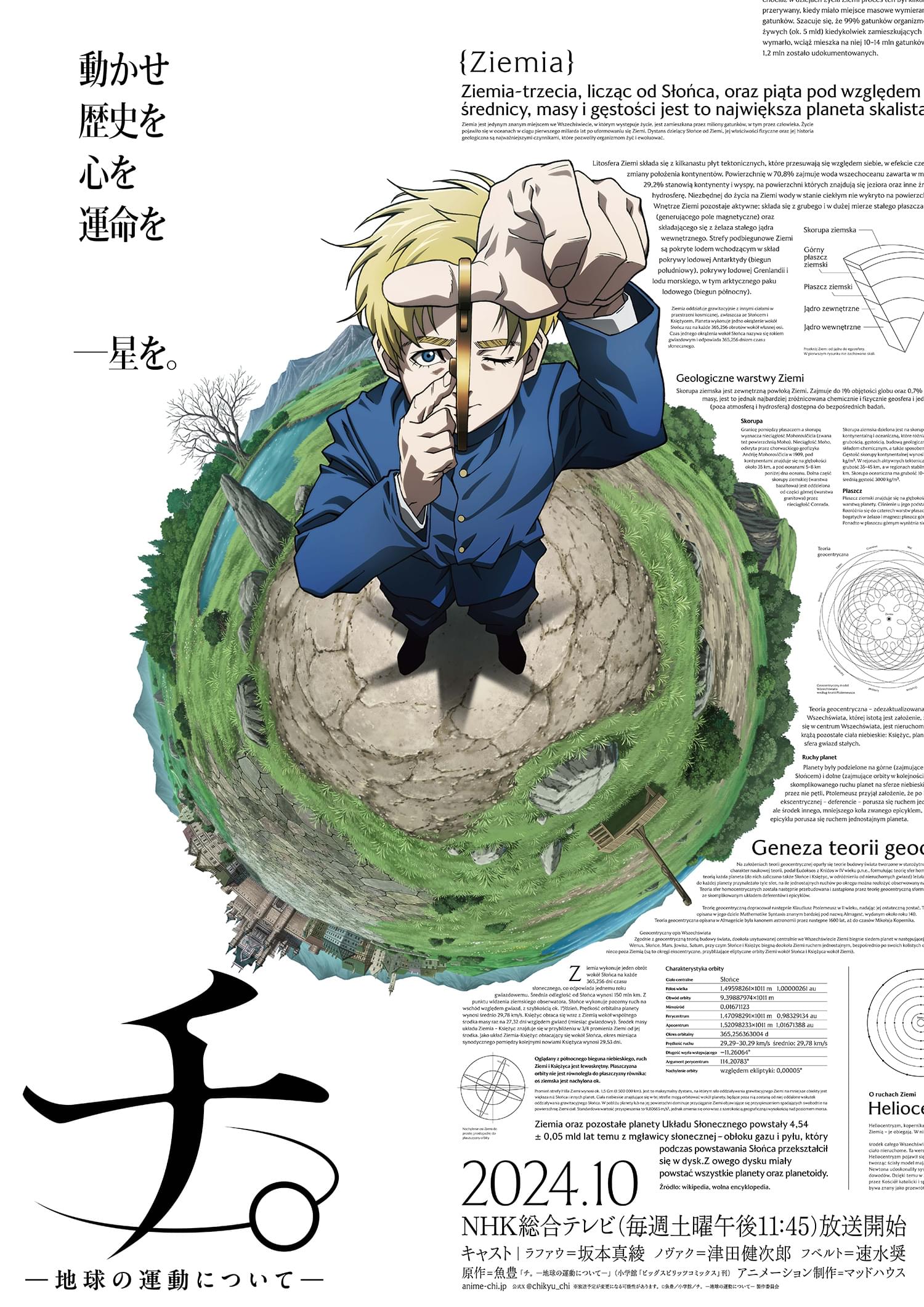
Quoted from the official site https://anime-chi.jp/