

The day I left Sapporo, where I live, the morning temperature was indeed 16°C. Thinking how chilly it had gotten, I boarded the plane and arrived in Kyoto to take part in Japan's biggest festival of film score. The temperature: 36°C. A number more than double—and it wasn't kidding around; it was scorching…
But there's no way my heart wouldn't race for an event even hotter than that. So—here's my report on the Kyoban Festival, the eve of Kyoto's anime festival Kyomafu!
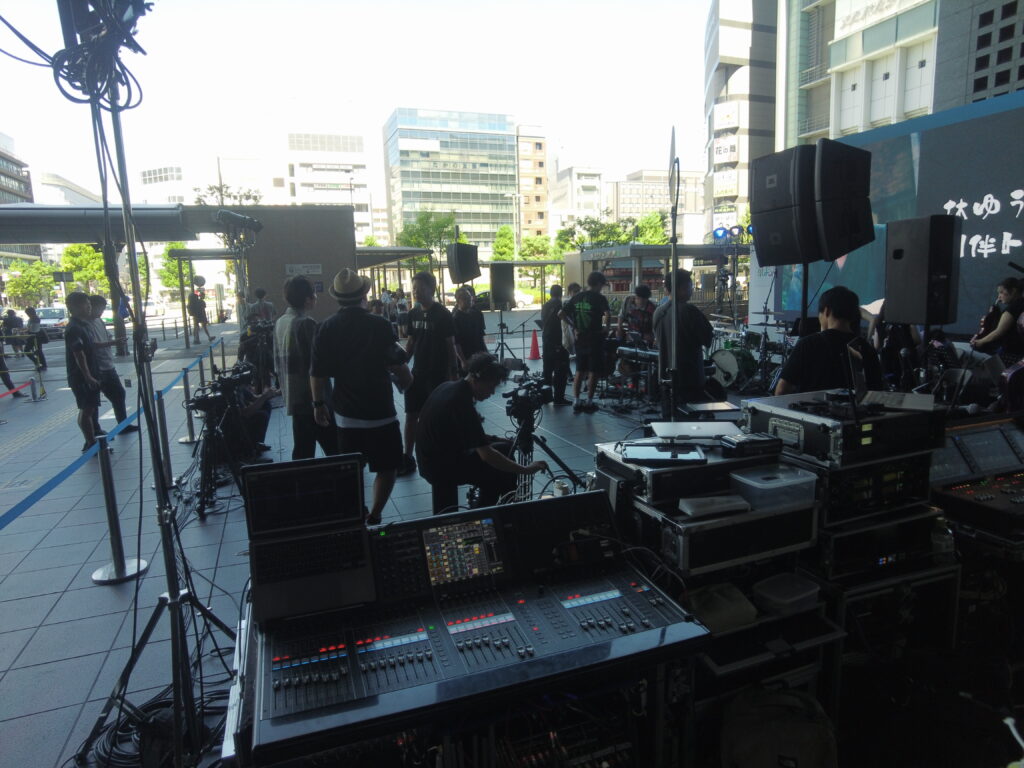
The eve event in preparation. People passing through Kyoto Station grew curious and stopped to look, too.
First up was the indie anime “Manabi-ishi to Jiyucho” (The Learning Stone and the Free Notebook). VTuber Serasu Amasaki took the stage as MC, and director Mizumizu Namazu and Rin—who normally also works as an actor—took the stage as well, and the three of them talked about this anime. You can watch the work's PV on YouTube too, so please give it a look.
I was stunned after watching the whole PV. This is indie?? I was even more stunned to hear it was all written and made by a single person. Do you have any idea how many steps go into producing an anime…!
Of course, since it's all made by one person, there are spots where the key animation and in-betweens feel a bit rough—but the score, handled by Arisa Okehazama, is a perfect match for the beautiful visuals: grand yet gently blending into everyday life, with a tender piano melody that lets you feel the town growing richer through the presence of the “learning stone.” The wonder of this anime's score felt like it wrapped everything up so well that the rough parts stopped bothering me at all. Incidentally, the work itself is set to release in 2025.
Showing the First 5 Minutes
The content the audience was curious about—the flow turned to showing the anime's first 5 minutes.
I was intrigued by the mysterious swirly cat that suddenly appears right at the start. The dog is somehow rainbow-colored too, and the gap from common sense gives you a truly strange sensation. And yet, strangely, it also clicks. I felt that's just how thoroughly crafted this anime's worldview is. The background art is exquisitely detailed, and the Japanese scenery somehow gives you a nostalgic feeling. And what sets off that scenery is, again, the score.
A sound with a reserved grace, where the strange and the real don't drift too far apart; a sound containing excitement and anticipation about what's going to happen; a gentle sound that keeps the perspective of something happening within this world. A sound containing the fear and loneliness the characters feel… Just the music that played in the anime's first 5 minutes moved my emotions in so many ways. About this anime's score, the composer Arisa Okehazama said something like, “I drew inspiration from striking moments—a cut where the camera moves from a little hill and the wind looks pleasant, for example. I was conscious of keeping the number of notes small, so that you can feel a sense of openness.” It seemed as if meaning was packed into each and every sound.
The Work's Setting
The setting is Manazuru, Kanagawa Prefecture (a town that really exists, next to Yugawara near Hakone). It retains an old townscape but isn't particularly a tourist spot; it's a seaside town built gently sloping toward the ocean, and the director said its diorama-like quality, surrounded by mountains, felt perfect for a short film.
He went location-scouting all over, and apparently decided on this place after feeling things like “it'd be nice to have people here” and “this would make a good picture.”
According to Rin, who said she'd watched the work three times, it's a piece that makes you think about all sorts of things, that she'd recommend to every generation, and that lets you take a fresh look at your own life. I'm looking forward to its release.
What the Director Poured Into the Work
The hard part of making the work, he said, was the loneliness—because the background art, key animation, in-betweens, scenario, and planning were all done by one person.
Animation is basically made as a team, with work divided up and opinions exchanged, but doing it alone meant there was no such synergy, and it was hard to keep his motivation up.
He said that having people learn of its existence through crowdfunding, taking an interest in his doing it solo, and cheering him on became a huge source of motivation.
At the end, the director said this work was made about people who are creating something or pouring themselves into something.
He wants it to reach all sorts of people, but he especially hopes it reaches aspiring creators.
That, he said, is the feeling he poured into this work.
Finally, when asked with what intent he created the “learning stone”—the hook of the work and the symbol that gives it its title—he said that, being a fan of tokusatsu, he depicted it as a symbol in the vein of how the mere presence of something uncanny sets a story in motion: as a catalyst for the story, and as the symbol of a work that's fantasy yet not fantasy.
If this piqued your interest, please do check out Mizumizu Namazu's X.
![[Grand Finale] Japan's World-Class "Film Score" Festival! Report From the Day Kyoto Was the Hottest Place in Japan: ~The End of the Festival~](https://lh7-rt.googleusercontent.com/docsz/AD_4nXeQ3v4vT4vYZ3gqjtqxpOCznnXOIbHJG7LtyMoObLex0PdioDc4tXkl61hhVOeG57eg3-4OkIcO66j6rBNkQiaAIkHGf-oKFHWXrbCaLDQnfnFOx8kxP2YNCa4vORqeJgRCfdK9kacPXqc_tyOYPCQpeyzg?key=9TEImc1vGP6ZD2O_F6ImQg)
![[Penultimate Act] Japan's World-Class "Film Score" Festival! Report From the Day Kyoto Was the Hottest Place in Japan: The Kyoban Festival Main Event, Part 4](/assets/img/2024/09/dji_mimo_20240922_193940_906_1727068533682_photo-1024x768.jpeg)