

I'm writing this article right after going to see the theatrical anime "Look Back."
The original is by manga artist Tatsuki Fujimoto. This work was published as a one-shot on Jump+ in 2022, and its overwhelming quality drew universal acclaim.
I'd read the original, of course, but it didn't really resonate with me at the time.
An anime film adaptation? At first it didn't click for me, but when I heard you could hear people sobbing in theaters, I got curious and went to see it.
The runtime is 58 minutes, quite short for a film.
And yet the content is a relentless, overwhelming surge of emotion. It made me forget the very concept of time, leaving me wanting to stay there for two or three hours.
What's more, the fact that a director named Kiyotaka Oshiyama wrote almost everything by himself, from the script to the storyboards to the key animation, is a staggering display of creator's spirit.
The story: a girl named Fujino, who serializes a four-panel comic in her elementary school's grade newspaper, is told by a teacher to let Kyomoto, a shut-in girl, take one of the two four-panel slots. When she actually has her draw, the background work is so tremendously brilliant that everyone at school starts to think Kyomoto might be better at drawing than Fujino. Frustrated by this, Fujino throws herself into studying art intensely, but unable to close the skill gap no matter how many years pass, she gives up drawing and quits manga. However...
In the film, a deeply shocking incident occurs, and Fujino feels regret so profound she can never make up for it, blaming herself, when, as if in answer, a four-panel comic arrives from beyond a door. At that moment there are no lines or anything, so what it's trying to say is left to the reader's imagination, but I think it probably wanted to say thank you.
Now, this work has especially wonderful music. A series of crystal-clear, translucent sounds, so much so that I ended up buying the soundtrack on my way home.
The composer is haruka nakamura. He's handled "Animal Crossing" in games and "Hikikomori Sensei" in dramas.
The music has a real healing effect, and listening to it felt like it cleansed my soul.
Track 2, "Kuso no Kanata de" (Beyond the Daydream), is the music that plays when Fujino's four-panel comic is animated in a world of fantasy. I was surprised to see in the title credits that the heroine's role is voiced by Maaya Sakamoto. The music being comical is delightful, and it's the kind of track that makes you feel like you've just read Fujino's manga.
And since this is a score column, I'd intended to avoid music with vocals like theme songs as much as possible, but it was so wonderful that here's a track I absolutely want to introduce: "Light song." Sung by someone named urara, it stood out conspicuously amid the overall translucent music.
Finally, as always, let's part ways after watching the theatrical preview.
It'll surely stream once the theatrical run ends, but this is a work I really want you to see in theaters.
It's a film that will surely strike a chord with every creator, athlete, and anyone who holds a dream.
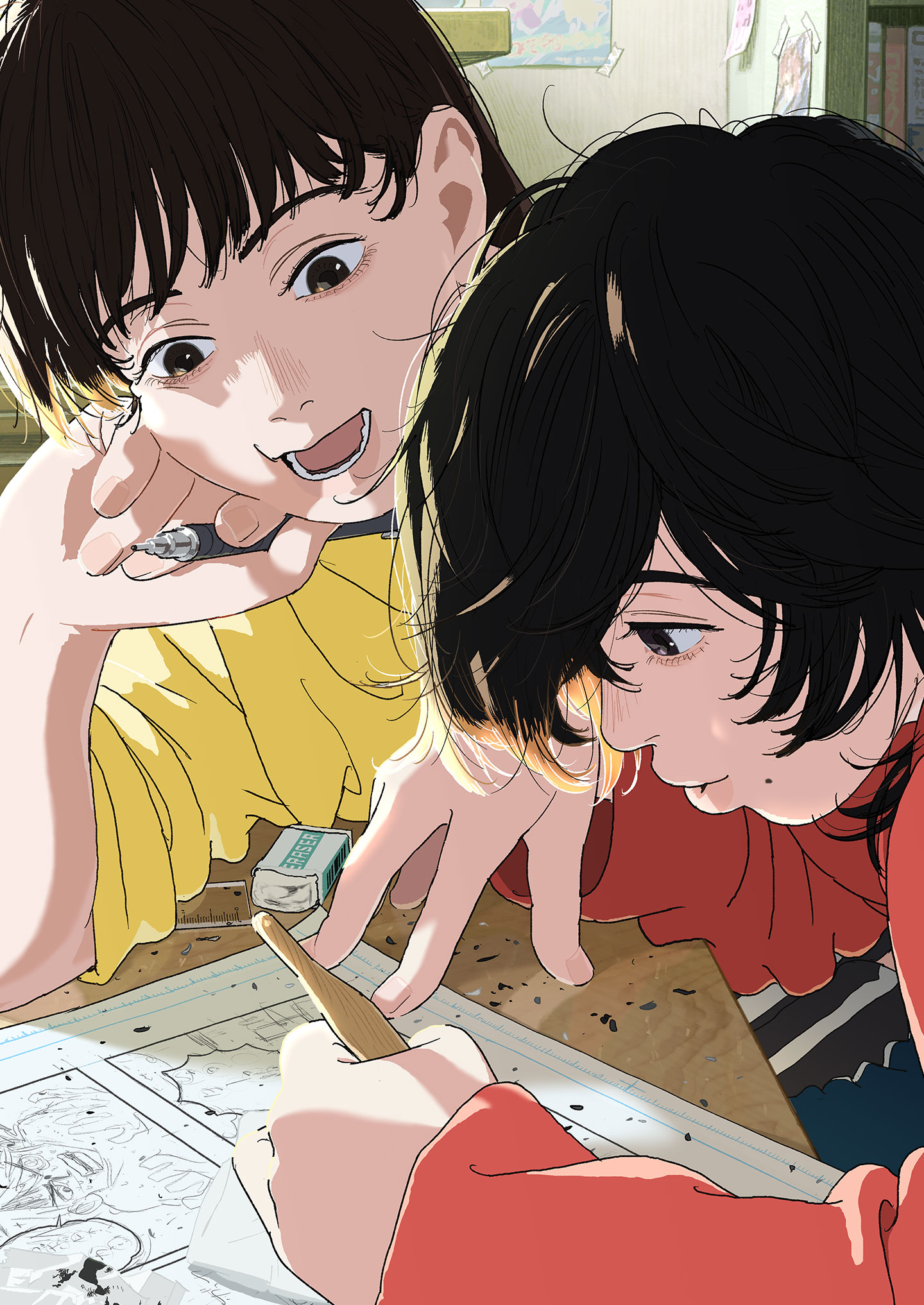
Quoted from the official site https://lookback-anime.com/