

This is Part 2. Last time I could only talk about up to the first half of the film, but in Part 2 I want to discuss the rest. That said, the true final stretch has too many parts I can't explain without spoilers, so I'll have to rush through it, but I'll do my best to talk it through.
First, continuing from last time, the scene after graduating elementary school, when Fujino meets the other protagonist, Kyomoto, for the first time. In the pouring rain, she heads home without even opening an umbrella, dancing as she goes, soaked to the bone. It's probably one of the one or two most memorable scenes in all of Look Back. The music that plays here is incredibly bright and sunny, despite the rain. Beautiful strings and piano, as if a break in the clouds is letting sunlight through and warm rays are pouring down. Thoroughly bright chords are used, and the chord progression rises from the tonic, just like Fujino's mood. The tonic is the chord of resolution and landing. Only here does she finally learn that Kyomoto, whom she'd seen as a rival, was actually her own fan. She can be certain her efforts weren't in vain. Why do creators make their works? How can they keep facing themselves without quitting even after years of going unrecognized? It's because they have the memory of making a work, being recognized by others, and receiving a good evaluation. It's because they have a success experience. With that, even under a cloudy sky, they can break into a run while skipping. That has nothing to do with whether you're selling well or have name recognition; in the end, I think every creator is struggling within that very cycle of repetition. And those who lose that supply of "being recognized by others" are, one by one, the ones who become unable to make works anymore.
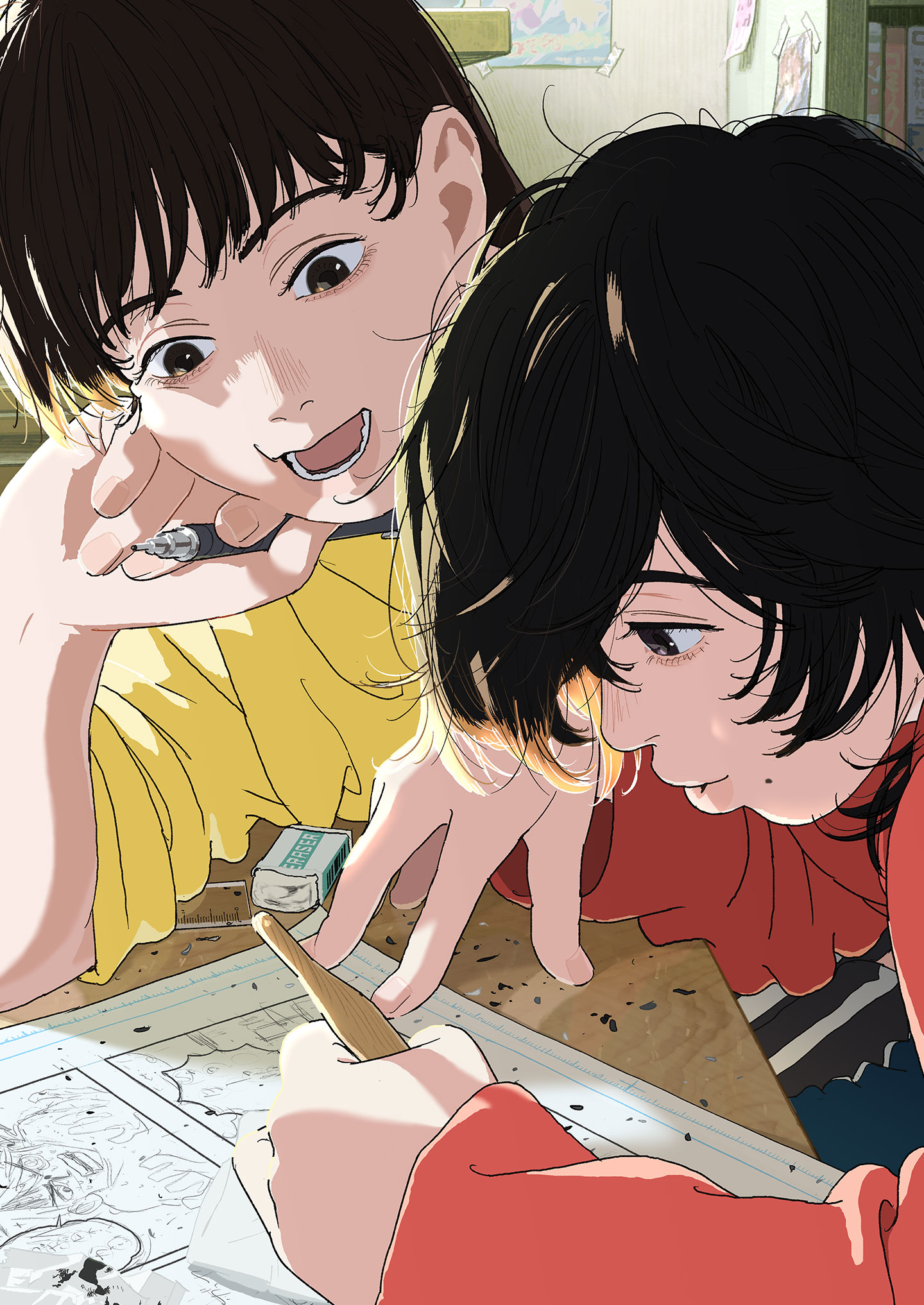
After that, the two become friends and create manga together. And the manga they complete earns praise high enough to reach the first step toward their dream. The score plays again. Like the piece above, it's a sunny, gentle one. But the piano has a lot of notes, undulating as if dancing up and down the scale. That light, nimble melody overlaps perfectly with the feelings of two girls who've leapt into an unknown world, hearts pounding with excitement.
The scene shifts further, to where the two go on to create work after work based on all kinds of experiences. Fundamentally, this work has many scenes that, with few words, express the two's relationship and their feelings at the time through the power of music and art. That's surely why Look Back captured the hearts of so many creators. The music used in this scene, too, should feel different on a first viewing versus a second. On the first viewing it sounds like a calm, fulfilled, gentle piano piece, a positive piece characterized by the sounds of xylophone and glockenspiel. I can't write my impression of the score on the second viewing in detail, because doing so would be a massive spoiler, but the reverse sounds I discussed in Part 1 are the key.
The next scene where the score plays is when serialization begins and things get busy. In a complete reversal from the piano-and-strings-centered orchestral sound up to now, it becomes a mechanical sound with electronic tones as the main element. The tempo is fast, with an atmosphere of busy daily life. Even so, there's no pessimistic resonance in it; instead it has a grand sonic flow that evokes new challenges, a new environment, and the enormous hours spent facing one's own work. In particular, from around when the snare drum comes in, you can also feel a kind of reliability, as if something like confidence is gradually budding.
The score for the next scene is something I can't really discuss without spoilers. It's the scene where, on a first viewing, viewers first realize the meaning of the reverse sounds I've been talking about since Part 1. Please, definitely watch Look Back and listen to it for yourself. The same goes for the scene after this. As for this part, it's built with a piano-only sound. Not a single reverse sound comes in. From here on, I can't talk about it without spoilers. And so, whether you've already watched it once or haven't seen it yet, please definitely watch Look Back with an ear on the score. It is, without a doubt, a great masterpiece.
Quoted from the official site https://lookback-anime.com/